

Most generic ERPs break in a sports goods factory within the first quarter because they were not built for size-variant explosion, seasonal demand spikes, and export paperwork happening at the same time. The right system for a Jalandhar or Meerut unit needs variant-level BOMs, batch QC, and order-to-export tracking working together, not bolted on. This guide compares the real options for 2026 so you can pick based on your order book, not a feature list.
Why does sports goods manufacturing break generic ERPs?
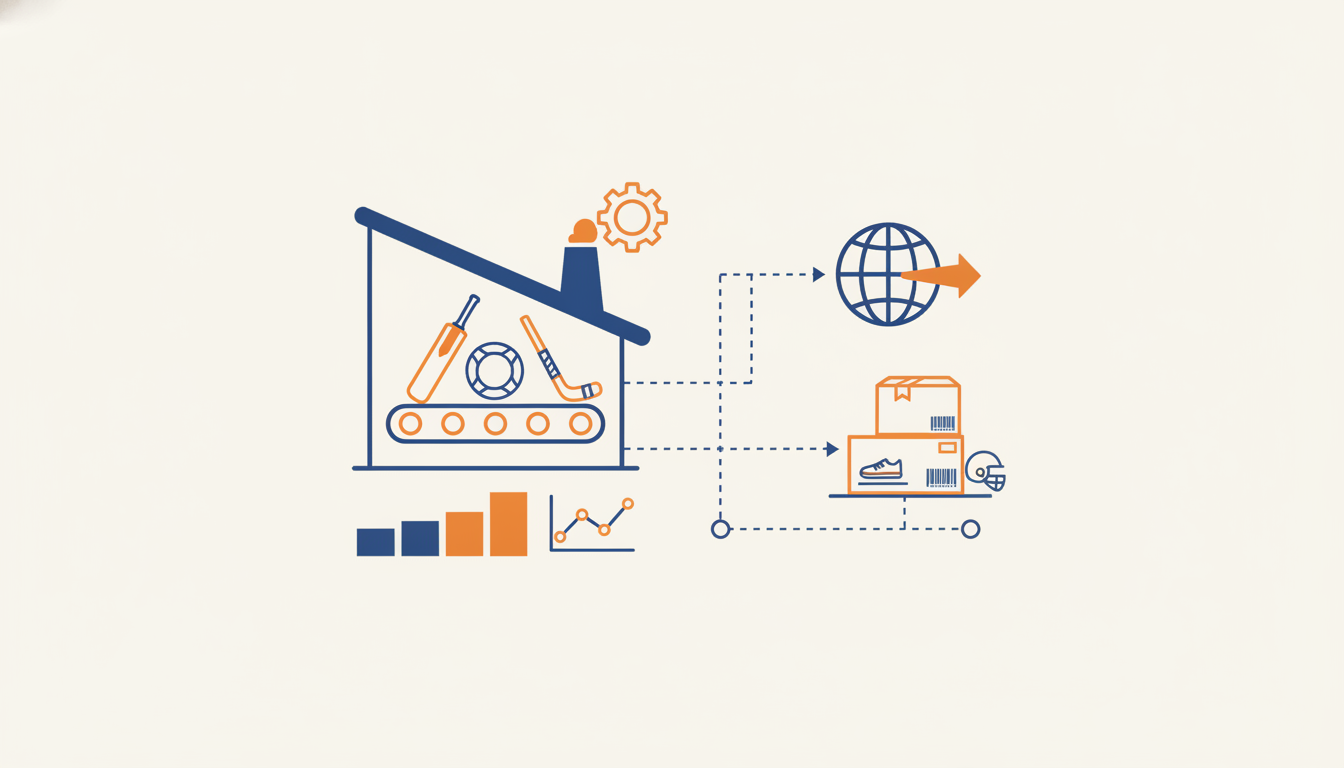
Sporting goods units run a manufacturing pattern that most off-the-shelf ERPs simply were not designed around.
A cricket bat, football, or gym glove line usually has:
- Seasonal demand swings — export orders for winter sports gear peak months before shipment, while domestic cricket demand spikes around IPL season. Your ERP needs to plan capacity against uneven order flow, not a flat monthly forecast.
- Size and variant explosion — a single football style might ship in 3 sizes, 4 colorways, and 2 stitching grades. That is 24 SKUs from one design, each needing its own bill of materials and costing.
- Heavy job-work dependency — stitching, tanning, and finishing are frequently outsourced to job workers in the same cluster. Tracking material sent out, received back, and wastage across job-work vendors is a distinct workflow that plain inventory software does not model well.
- Export order complexity — a single export order can carry multiple size-wise packing lists, country-specific labeling, and staggered shipment dates.
Tally and Excel handle none of this natively. Zoho and Busy handle inventory reasonably but were not built around variant BOMs or job-work. This is the gap that decides whether an ERP saves you time or becomes another spreadsheet you maintain in parallel.
What are the 6 capabilities that actually matter?
Skip the glossy feature lists and check for these six specifically, since they map directly to how a sports goods unit operates:
- Variant BOM management — one master BOM that expands automatically by size, color, and grade, instead of maintaining 24 near-identical BOMs by hand.
- Batch-wise QC — defect and rejection tracking tied to production batches and job-work vendors, so you know which batch or vendor is driving returns.
- Order-to-export tracking — a single order visible from raw material allocation through production, packing list, and shipment, not three disconnected spreadsheets.
- Dealer/B2B catalog — a catalog your domestic dealer network and distributors can browse and order from directly, with pricing tiers by dealer type.
- GST and export documentation — e-invoicing, GST returns, and export paperwork (shipping bills, packing lists) generated from the same order data, not re-typed.
- D2C channel sync — if you also sell on Shopify or Amazon, inventory needs to sync so you are not overselling stock that is committed to an export order.
Miss any one of these and you end up running a second system alongside your ERP, which is close to running no ERP at all.
How do the major options actually compare?
Here is an honest read on where each option fits, based on company size and complexity, not marketing claims.
- Option — Best fit — Where it falls short for sports goods
- Tally + Excel — Micro units, single product line, no exports — No variant BOM, no batch QC, export docs manually recreated every time
- Busy — Small units focused on GST/accounting compliance — Strong on invoicing and GST, weak on production planning and variant handling
- Zoho Inventory — Small-to-mid units selling mostly online, low manufacturing complexity — Good stock and order sync for D2C, but BOM and job-work tracking are thin
- Odoo — Mid-size units with in-house IT capacity to customize — Genuinely flexible and can be configured for variant BOMs and job-work, but needs a skilled implementation partner and ongoing customization; underestimated by many buyers
- SAP Business One — Larger exporters (₹50 crore+ turnover) with complex multi-entity operations — Full-featured and well suited to scale, but implementation cost and timeline are heavy for a mid-size sports goods unit
- OmniSuite — Small-to-mid sports goods manufacturers and exporters, especially in the Jalandhar/Meerut clusters — Purpose-built around order-to-export tracking, batch QC, and B2B catalog for exactly this segment; newer platform than SAP B1, so enterprise-scale multi-entity finance is not its focus
Odoo deserves a fair mention here: for a unit with an in-house developer or a strong implementation partner, it is a genuinely capable and flexible option, and often the right call if you need deep customization beyond manufacturing (like HR or advanced accounting) in one system. SAP B1 is the right answer once you are a larger exporter with multi-entity, multi-currency operations where the implementation cost is justified by scale.
For a sports goods unit doing ₹5-40 crore in turnover with export orders and job-work vendors, this is exactly the segment OmniSuite was built for. If IIoT-level shop floor visibility (machine uptime, real-time production data) matters to your operation, it is worth reviewing what ERP with IIoT integration looks like alongside this, since sports goods units with automated cutting or molding lines benefit from that data feeding directly into planning.
What does each option actually cost?
Rough ranges as of 2026, including the hidden costs buyers usually miss:
- Tally + Excel: Near-zero licensing (Tally is often already owned), but the real cost is staff time spent reconciling spreadsheets and manually preparing export documents. Expect 15-20 hours a week of manual data entry once you cross 500 SKUs.
- Busy: Roughly ₹18,000-35,000 per year for licensing. Cheap to start, but you will still need a separate system or spreadsheet for variant BOM and job-work tracking.
- Zoho Inventory: Roughly ₹15,000-60,000 per year depending on user count and modules. Implementation is fast, but customization for variant BOM often requires a Zoho partner at extra cost.
- Odoo: Licensing itself can be modest, but implementation and customization for manufacturing-specific workflows commonly runs ₹3-8 lakh depending on partner and scope, plus ongoing support retainers.
- SAP Business One: Implementation typically starts around ₹8-15 lakh and can go well beyond that for multi-entity setups, with annual maintenance on top.
- OmniSuite: Implementation-inclusive pricing scoped to sports goods workflows; exact numbers depend on order volume and export complexity, best confirmed on a demo call rather than estimated here.
The hidden cost across almost every option is implementation time, not the license fee. A system that looks affordable on paper but takes six months to configure correctly is costing you in delayed exports and manual workarounds during that gap. Factor implementation timeline into your comparison as seriously as the subscription price.
Why does implementation partner matter more than the feature list?
Two ERPs with identical feature checklists can produce completely different outcomes depending on who implements them. This matters more in sports goods than in most other industries because:
- Cluster-specific job-work practices vary between Jalandhar, Meerut, and other hubs, and a partner unfamiliar with local vendor arrangements will build workflows that do not match how your job-work actually runs.
- Export documentation formats differ by destination country and buyer, and a generic implementation team often treats this as an afterthought rather than a core workflow.
- Ongoing support responsiveness matters once your production floor depends on the system daily. A partner three time zones away, or one that treats support as a ticket queue, slows you down exactly when you cannot afford it.
This is also why proper inventory management software sits at the center of the decision. Inventory accuracy across raw material, work-in-progress, and finished goods by variant is the backbone every other module depends on. If that layer is weak, the rest of the ERP inherits the problem.
We work with sports goods exporters in the Jalandhar cluster and have seen firsthand how much the feature list understates the real decision, which is whether the implementation team understands your actual production floor.
See how OmniSuite handles this end-to-end — book a 30-minute demo at omnisuite.techinject.in.
Next step
If you are still running production on Tally and Excel and starting to feel the strain of variant SKUs or export paperwork, the fastest way to know your real options is a working demo against your own order data, not a generic feature walkthrough. You can also browse more manufacturing ERP breakdowns on the Tech Inject blog before deciding. Book a 30-minute OmniSuite demo at omnisuite.techinject.in and bring your current SKU list and one recent export order to walk through.
FAQ
What is the most affordable path to get started?
If you are a micro unit with a single product line and no exports, staying on Tally with disciplined Excel tracking costs the least upfront. The tradeoff is manual hours spent on variant tracking and export documentation, which grows fast once you cross a few hundred SKUs or start exporting regularly.
How long does migration to a new ERP actually take?
For a small-to-mid sports goods unit, a focused implementation (data migration, variant BOM setup, user training) typically takes 6-10 weeks with an experienced partner. Larger, multi-entity setups like SAP B1 commonly run 4-6 months. The biggest time sink is usually cleaning up historical inventory and BOM data before migration, not the software setup itself.
Does the ERP work offline on the factory floor?
Most modern ERPs, including OmniSuite, are cloud-based with mobile or tablet interfaces for the shop floor, which need stable connectivity. If your factory floor has unreliable internet, ask any vendor specifically about offline data capture and sync behavior before signing, since this varies significantly between platforms and is often glossed over in demos.
Can I switch from Tally without losing my existing GST and accounting history?
Yes, a proper migration should import your historical GST filings, invoices, and ledger data rather than starting fresh. Confirm this explicitly with any implementation partner and ask to see a sample migration of accounting history before committing, since data continuity is where botched migrations usually go wrong.
Is Odoo a reasonable choice if I already have an in-house developer?
Yes, genuinely. Odoo's flexibility is a real strength if you have technical capacity to configure and maintain it, and it can match purpose-built options on functionality with the right customization. The tradeoff is that this configuration work and its ongoing maintenance sit on your team rather than a specialized vendor.