

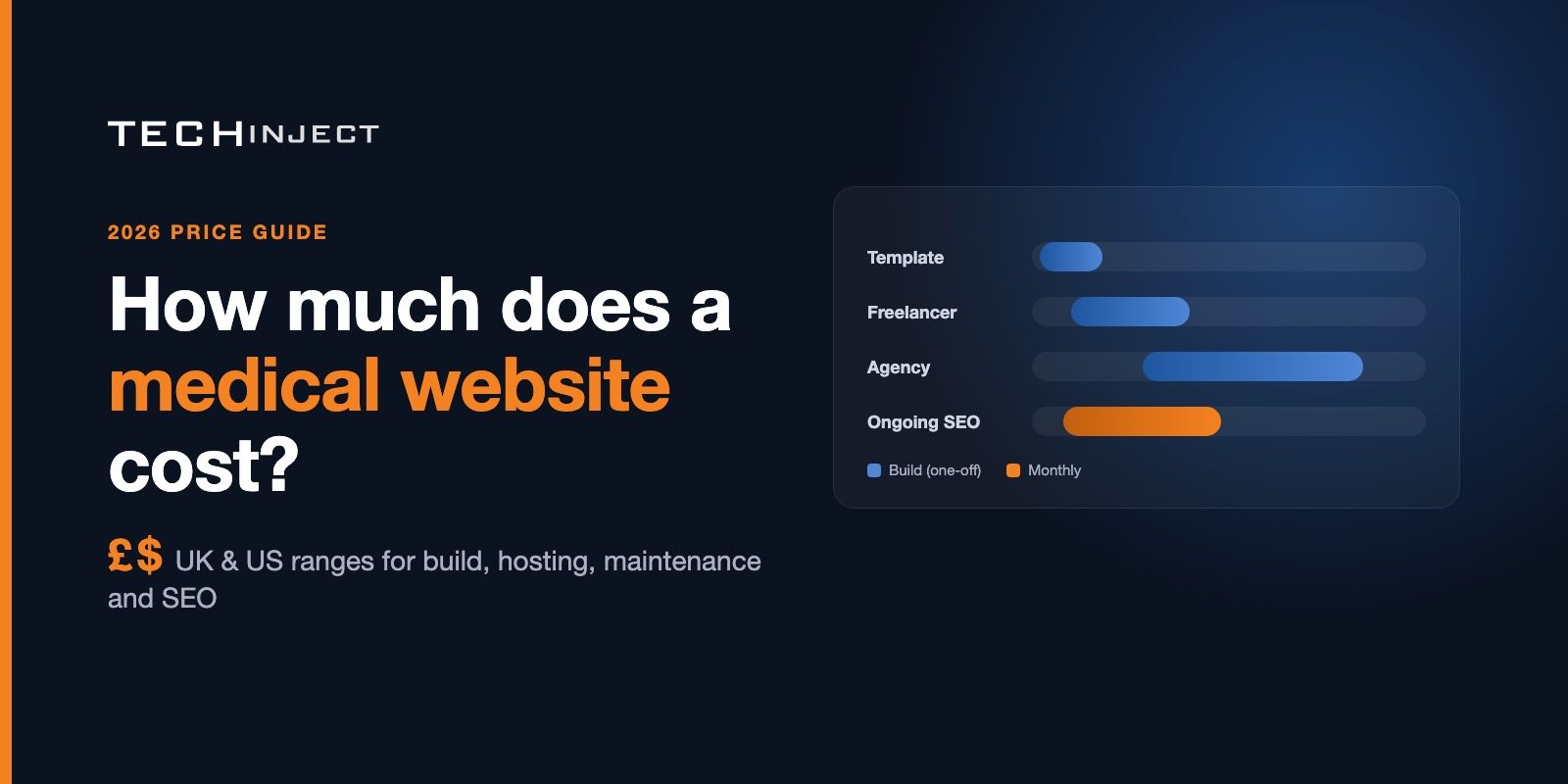
Ask three agencies what a medical website costs and you will get three very different numbers. That's not because anyone is hiding something. A "medical website" can mean a five-page template for a single consultant or a twenty-page multi-location clinic site with online booking, secure forms and a monthly SEO programme. This guide breaks the medical website cost into its four real parts (build, hosting, maintenance and SEO), explains what moves each one, and gives published 2026 price ranges for the UK and the US, each in its own currency.
All figures below come from published 2026 pricing guides and vendor pages, linked inline. Treat them as planning ranges, not quotes.
What Drives the Cost of a Medical Website?
Most of the price difference between two medical websites comes from a handful of decisions. Before comparing quotes, decide on these.
- Page count and structure. A consultant with three procedures needs far fewer pages than a clinic with six specialties, several practitioners and patient-information pages. Each service page needs its own copy, images and on-page SEO.
- Custom design vs. a template. Template builds are faster and cheaper. Custom design costs more but lets the site reflect your brand and the way patients actually choose a clinician.
- Copywriting and clinical review. Medical copy has to be accurate, plain-English and compliant with advertising rules (GMC guidance and the CAP Code in the UK, state medical board rules and FTC guidance in the US). Someone has to write it and you have to approve it. If the quote assumes you supply all the text, the price will look lower than it really is.
- Online booking and EHR integration. Linking to a booking page is cheap. Embedding a scheduler with conversion tracking costs more. Building a custom booking system, or a deep integration with an EHR or practice-management system, is a project in its own right.
- Secure forms and patient data. A contact form that only asks for name, email and phone is simple. Once a form collects health information, the rules change. In the US that means using a HIPAA-compliant form or intake provider that will sign a Business Associate Agreement (BAA). In the UK it means UK GDPR's stricter rules for health data, secure hosting and usually a DPIA.
- Accessibility. Building to WCAG 2.1 AA is good practice everywhere. It supports your duties under the Equality Act 2010 in the UK and reduces ADA risk in the US. A separate accessibility audit is an extra line on the invoice.
- Multiple locations and practitioners. Each real clinic location needs accurate address details, its own location signals and, where patients genuinely visit, a dedicated page. Multi-provider sites need bios, credentials and filtering.
Template Platforms vs. Agencies vs. Subscription Platforms
There are three common ways to buy a medical website, and the biggest difference between them is not the price. It's who owns the result.
- DIY / template builder — Upfront cost: Lowest; Ongoing cost: Monthly plan; Who owns the site?: You own your content; the site lives on the builder's platform; Best for: New practices testing demand on a tight budget
- Freelancer or agency build — Upfront cost: Moderate to high; Ongoing cost: Hosting, maintenance and SEO, billed separately; Who owns the site?: Usually you: code, domain and accounts, if the contract says so; Best for: Practices that want a custom site and the freedom to switch providers
- Healthcare subscription platform — Upfront cost: Setup fee, often lower than a custom build; Ongoing cost: Monthly fee that bundles hosting and limited updates; Who owns the site?: Often the vendor: templates and code stay with the platform; Best for: Practices that want one bill and are happy to stay with one vendor
Subscription platforms are a reasonable choice for many practices, but read the terms. For example, DocSites advertises builds "as low as $1,999 setup & $89 per month", including hosting and up to one hour of updates by request. Its terms also say its templates are proprietary, so you "may not take the website elsewhere after cancelling", though you keep your content and your domain. Several other US healthcare platforms, including Tebra's practice marketing product, don't publish website prices and quote on request.
Ownership is a cost. If you can't move the site, switching providers later means paying for a rebuild.
Hidden Costs to Budget For
Once you add up the extras, a quote can grow by a third or more. Whito's 2026 UK data puts hidden extras at 30 to 50 per cent on top of the quote. The usual culprits:
- Copywriting and photography. Professional clinic and headshot photography, and copy for every service page.
- Booking and intake tools. Third-party schedulers and HIPAA-compliant form providers usually charge their own monthly fees on top of the website.
- Secure hosting and compliance paperwork. Hosting suitable for health data costs more than standard brochure hosting, and a DPIA or BAA review takes time.
- Accessibility audits if they aren't included in the build.
- Domain, email and paid tools. Domain renewals, business email, review-management software and SEO tools.
- Content changes after launch. Many plans include only a small number of update hours each month.
- Exit costs. Rebuilding the site if your platform won't let you take it with you.
Look at three years, not just the build. Kolonell's October 2026 comparison of London clinic projects puts the three-year total for a freelancer-built clinic site under £16,000, against £28,000 to £50,000 for an agency, with hosting and maintenance making up much of the difference.
Red Flags When Getting Quotes
- Guaranteed rankings. No one controls Google's results. Promises such as "page one in 30 days" are a warning sign, and Dominate Dental's UK guide notes that guarantees like these go against Google's guidelines. Ask how progress will be measured from a baseline.
- Platform lock-in. If the provider owns the domain, the hosting account, the code or your Google Business Profile, you can't leave without starting again. Get ownership of every account in writing.
- Very cheap SEO. A real local SEO programme needs technical work, content and reporting every month. Monthly retainers well under £500 or $500 usually mean automated directory submissions and little else. The same Dominate Dental guide says comprehensive SEO offered for under £800 a month typically relies on automated tools.
- Health-data fields on a standard form. If a quote includes forms that collect symptoms or medical history but says nothing about secure processing (or, in the US, a BAA), the provider hasn't thought about compliance.
- A single-line quote. A credible quote separates design, build, copy, integrations, hosting, maintenance and SEO, so you can see what you're paying for.
Medical Website Costs in the UK
UK pricing splits clearly between freelancers, general web agencies and healthcare specialist agencies. The table gives published 2026 ranges.
- Build (one-off) — Low: £1,500–£3,000 (freelancer, five-page brochure site); Typical: £3,000–£10,000 (professional business site to freelancer-built 20-page clinic site); High: £14,000–£26,000 (agency-built 20-page clinic site)
- Hosting — Low: £130–£160/year (self-hosted WordPress); Typical: £150–£500/year (standard brochure hosting); High: £600–£4,000/year (secure UK hosting, freelancer-arranged to agency-managed)
- Maintenance — Low: From £90/month; Typical: £90–£220/month (freelancer); High: £300–£700/month (agency)
- SEO — Low: £500–£1,500/month (freelancer); Typical: £1,500–£4,000/month (most dental practices); High: £3,500–£5,000+/month (premium packages, London)
Sources: build and hosting from Whito and Kolonell; maintenance from Kolonell; SEO from Dominate Dental (dental-sector figures, which are a useful proxy for private clinics).
A few UK-specific points:
- Day rates explain most of the gap. Kolonell puts London freelancers at £450–£550 a day and agencies at £700–£950 a day for the same kind of clinic project.
- Booking integration costs £300–£700 through a freelancer and £600–£1,400 through an agency (including conversion tracking), according to the same source.
- Accessibility is often outsourced by freelancers at £900–£1,800, while agencies either include it or charge £1,500–£3,000.
- Regulation shapes the copy. GMC guidance, the ASA's enforcement of the CAP Code (including the ban on advertising prescription-only medicines to the public) and UK GDPR all apply. Budget time for clinical sign-off.
- Consultants working across sites. If you see private patients at several hospitals or clinics, your SEO needs to reflect each real location, not create thin pages for towns you don't serve.
Where Tech Inject sits in the UK
Tech Inject builds websites for UK consultants and doctor-led private clinics from £1,450, with local SEO from £650 a month. Quotes are itemised, regulator-aware copy is reviewed by you before launch, and the domain, hosting, code and analytics are set up in your name. Our engineering team is based in India, with a UK sales contact. See medical website design for UK doctors.
Medical Website Costs in the US
US medical website pricing ranges from bundled subscription platforms to custom agency builds. The table gives published 2026 ranges.
- Build (one-off) — Low: $1,999 setup on a subscription platform, or $3,000–$5,000 for a template build; Typical: $4,000–$8,000 (small practice); High: $8,000–$20,000+ (custom or multi-location)
- Hosting — Low: Included in a subscription (for example, $89/month bundled with updates); Typical: $300+/year (medical website hosting); High: $100+/month (hosting and security)
- Maintenance — Low: $75/month (basic combined plan); Typical: $100–$300/month; High: $250+/month (maintenance, content updates and monitoring billed separately)
- SEO — Low: $399–$899/month (small-scale local SEO); Typical: $1,000–$2,500/month (local starter retainer); High: $2,500–$5,000/month (growth); $6,000+ for larger groups
Sources: build figures from Flamingo Agency, Big Apple Media and DocSites; hosting from Big Apple Media and DocSites; maintenance from Flamingo Agency and Big Apple Media; SEO from WebFX and Medesk.
A few US-specific points:
- Features add up quickly. Big Apple Media lists online appointment scheduling at $1,500–$3,000, multi-location management at $1,500–$4,000, patient portal integration at $2,000–$5,000 and telehealth at $3,000–$8,000.
- HIPAA applies to the data, not the whole website. A brochure site with a contact-details-only form doesn't handle protected health information. Once a form collects health information, use a HIPAA-compliant form or intake provider that signs a BAA, and add its monthly fee to your budget.
- ADA and accessibility. Website accessibility claims against US businesses are a real risk. WCAG 2.1 AA is the standard most often referenced, so make it part of the build specification.
- Directories are part of local SEO. Healthgrades, Vitals, WebMD and Zocdoc listings, consistent name, address and phone details, and a well-managed Google Business Profile all affect local visibility.
- Subscription platforms are often quote-only. Ask for the setup fee, the monthly fee, the minimum term and the exit terms in writing before you compare them with a custom build.
Where Tech Inject sits in the US
Tech Inject builds practice websites for US physicians and specialists from $2,950, with local SEO from $950 a month. Every site is designed to WCAG 2.1 AA, forms collect contact details only unless we connect a HIPAA-compliant provider that signs a BAA, and you own the domain, code and analytics. Our engineering team is based in India, with a US sales contact. See medical website design for US practices.
Frequently Asked Questions
In the UK, most clinic and consultant websites cost £3,000–£10,000 to build, with specialist agency builds at £14,000–£26,000. In the US, small-practice sites typically cost $4,000–$8,000 and custom or multi-location sites $8,000–$20,000+. Hosting, maintenance and SEO are extra.
Expect hosting, maintenance and, if you want to grow enquiries, SEO. Maintenance alone ranges from about £90 to £700 a month in the UK and $75 to $300+ a month in the US, depending on who provides it and what's included.
Often upfront, yes. Over several years the monthly fees can match or exceed a custom build, and some platforms keep ownership of the templates and code, so leaving means a rebuild. Check the minimum term and exit terms before signing.
Only the parts that collect, store or transmit patient health information. A contact form that asks for name, email and phone only is generally fine. If you collect health information online, use a HIPAA-compliant provider that signs a Business Associate Agreement.
Published UK ranges run from £500–£1,500 a month for freelancers to £1,500–£4,000 for typical practice retainers. Published US ranges run from about $400–$900 a month for small-scale local SEO to $1,000–$2,500 for a local starter retainer. Be cautious of anything far below these ranges.
No. Rankings depend on Google and on your competitors. A credible provider sets a baseline and reports monthly on impressions, clicks, rankings, calls and appointment requests.
A focused site of up to around eight pages usually takes four to six weeks once content, credentials and images are ready. Larger multi-location or integration-heavy sites take longer, and clinical approval of the copy often sets the pace.