


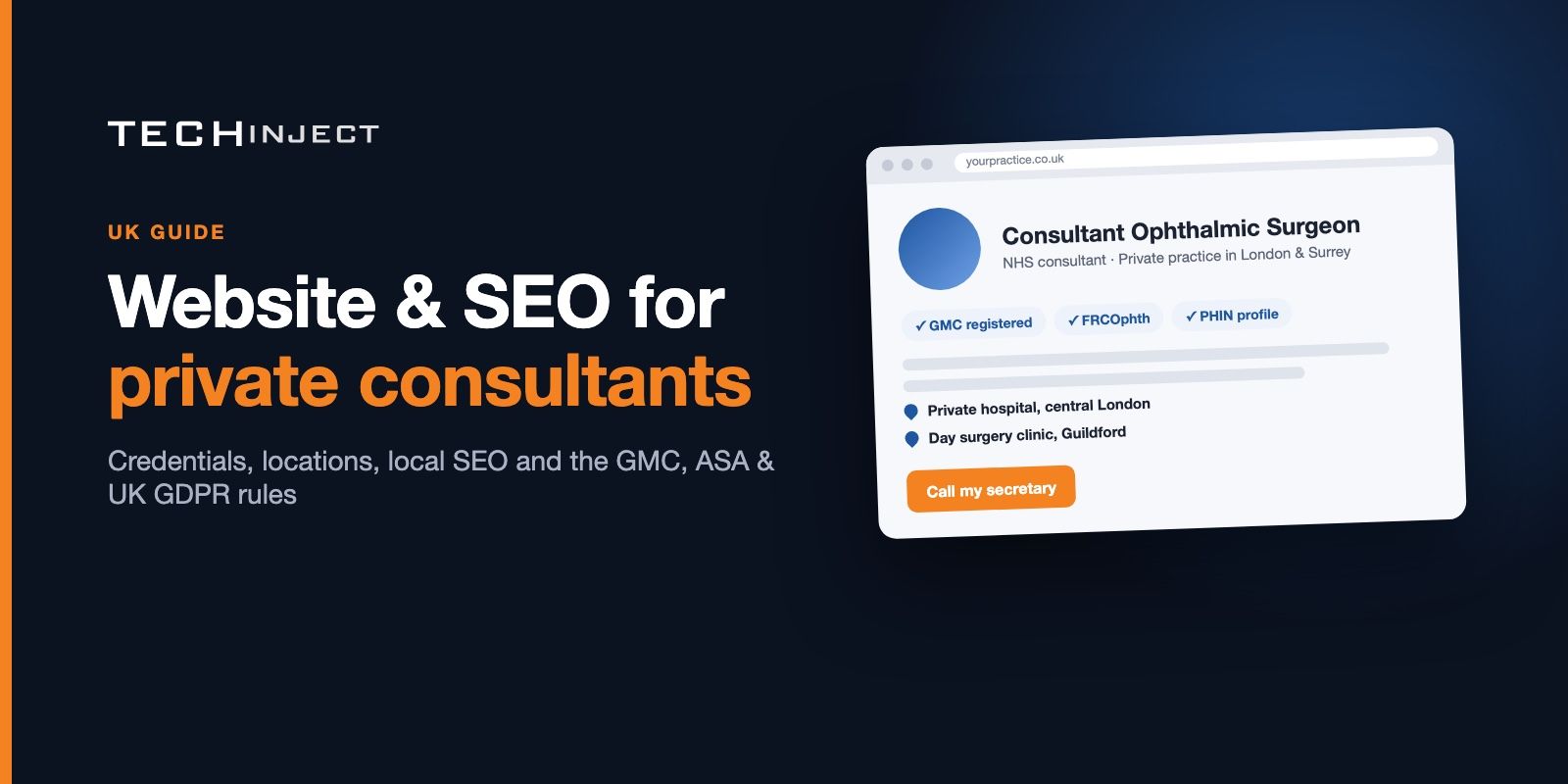
Most UK private consultants combine an NHS post with private lists at one or more hospitals or clinics. Patients look you up on Google, hospital consultant finders, Top Doctors, Doctify, PHIN and the GMC register. Each shows part of the picture. Your own website is the one place that shows all of it, in your words.
This guide covers what a consultant website needs, how it compares with directory and hospital profiles, local SEO across several locations, the rules on doctors' marketing, and what to measure. It is general information, not legal advice; check specific claims with your medical defence organisation.
Why Does a Private Consultant Need Their Own Website?
Private patients now have more choice and more information. PHIN's latest market update reports 247,495 private inpatient and day-case admissions in Q1 2026, with self-pay admissions up 7.7% to their highest ever level and 31% of admissions now self-funded. Self-pay patients choose their own consultant, often after searching by condition, procedure and town.
Fees are also public. Under the CMA's Private Healthcare Market Investigation Order, consultants submit their fees to PHIN, and the CMA reported in October 2025 that 96% of consultants publish their consultation fees for self-pay patients. When fees are easy to compare, the deciding factors become credentials, expertise in the patient's specific problem, location and how easy you are to book.
Google treats medical content with extra care. Its guidance says its systems give "even more weight" to content with strong experience, expertise, authoritativeness and trust on topics that could affect people's health, and that trust matters most.
What Should a UK Consultant Website Include?
A good consultant website is usually small: six to eight well-built pages beat thirty thin ones.
Credentials patients can check
Put the facts patients and GPs look for on your home and About pages:
- Your GMC number and specialist registration. Anyone can search the GMC's online register by name or reference number.
- Your NHS role. Trust, department and post, for example "Consultant Ophthalmic Surgeon, [Trust name]".
- Qualifications and memberships, written out in full so patients understand them.
- Hospital affiliations. The private hospitals and clinics where you hold practising privileges.
- Insurer recognition. Which insurers recognise you, if that applies, and that you see self-pay patients.
- A link to your PHIN profile, where your fees and activity data are published.
Keep every item current: an out-of-date membership claim is a misleading claim.
Condition and procedure pages
Patients search for problems ("cataract surgery Surrey", "knee pain specialist Manchester") more often than for names. Give each main condition or procedure you treat privately its own page, covering what the condition is, how you assess and treat it (including non-surgical options), what to expect, risks stated honestly, and where and how to book. Review every clinical statement yourself and avoid "best" or "leading" claims you can't prove.
Locations where you actually see patients
For each hospital or clinic where you consult, give the address, which days you are there, parking, accessibility and the booking route. Don't build pages for towns you don't serve: thin "consultant in [town]" pages mislead patients.
Secretary and booking routes
Private bookings often go through a medical secretary, a hospital booking team or an insurer. Make each route obvious:
- your secretary's direct phone number and email, shown on every page on mobile
- a simple enquiry form that asks for contact details only (more on this in the UK GDPR section)
- links to each hospital's booking page, if they offer online booking
- a short note on what patients need: GP referral, insurer authorisation or self-pay.
Own Website vs Top Doctors, Doctify and Hospital Profiles
Directories and hospital profiles are useful, and most consultants should have them. They don't replace a site you control.
- Who controls the content — Your own website: You; Directory platforms (e.g. Top Doctors, Doctify): The platform, within its templates; Hospital group consultant profile: The hospital's marketing team; PHIN consultant profile: PHIN, from data you and hospitals submit
- Shows all your locations — Your own website: Yes; Directory platforms (e.g. Top Doctors, Doctify): Usually, if you add them; Hospital group consultant profile: Usually only that group's sites; PHIN consultant profile: Yes, for private activity
- Other consultants on the page — Your own website: No; Directory platforms (e.g. Top Doctors, Doctify): Yes, often alongside competitors; Hospital group consultant profile: Yes, other consultants in the group; PHIN consultant profile: Yes, in search results
- Condition and procedure depth — Your own website: As much as you write; Directory platforms (e.g. Top Doctors, Doctify): Limited by the profile format; Hospital group consultant profile: Limited; PHIN consultant profile: No (data, not content)
- Reviews — Your own website: Only if you collect and publish them compliantly; Directory platforms (e.g. Top Doctors, Doctify): Platform-hosted reviews; Hospital group consultant profile: Varies by group; PHIN consultant profile: Patient feedback data where available
- Cost — Your own website: Build plus hosting, maintenance and optional SEO; Directory platforms (e.g. Top Doctors, Doctify): Depends on platform and plan; check the current terms; Hospital group consultant profile: Usually included with practising privileges; PHIN consultant profile: Required under the CMA Order
- If you move hospital or leave — Your own website: You keep everything; Directory platforms (e.g. Top Doctors, Doctify): Profile stays with the platform; Hospital group consultant profile: Usually removed; PHIN consultant profile: Updated by PHIN
Keep every profile accurate and consistent, and link each one back to your own site. Your website is the hub; the profiles point to it.
How Does SEO for Doctors Work Across Several Hospitals?
A consultant may see patients at three private hospitals, none of which they own. Google needs to understand which conditions you treat and where. That comes from:
- Location content on your site for each site you consult at, linked from your condition and procedure pages.
- Consistent details across the web. Your name, specialty, locations and phone number should match on your website, hospital profiles, directory listings and PHIN.
- Structured data. Schema markup (for example `Physician` and `MedicalClinic` types) helps search engines connect you to your locations and specialties.
- Relevant links from hospital profiles, professional societies, NHS trust and research pages. Don't buy links.
Is a consultant eligible for a Google Business Profile?
Sometimes. Google's Business Profile guidelines treat doctors as "individual practitioners". A practitioner should have their own profile if they operate in a public-facing role and "can be contacted directly at the verified location during stated hours". Some rules that matter for consultants:
- Where several practitioners share a location, the organisation has the location profile and each practitioner's profile uses their name only.
- A sole practitioner at a branded location should share one profile named "[brand]: [practitioner name]".
- No separate profiles per specialism, no duplicate profiles for one location, and no virtual offices.
The guidelines don't spell out how to handle a consultant who sessions at several hospitals. A cautious approach: create a profile only where you have regular, stated consulting hours, make sure each hospital's own profile is accurate, and let your website list every location.
Content that answers real questions
One focused article a month, based on questions patients ask in clinic ("How long after cataract surgery can I drive?"), builds relevance over time. Have the consultant review each one. Avoid ranking guarantees, fake reviews and paid links; none of them last.
Which Rules Apply to a Doctor's Website?
Your website is a public professional communication and usually an advertisement, so several sets of rules apply.
GMC: Good medical practice
Good medical practice, in effect since 30 January 2024, no longer has a separate advertising section. Paragraph 89 says any information you communicate as a medical professional must be "accurate, not false or misleading": you must take reasonable steps to check it, must not deliberately leave out relevant information, must not minimise or trivialise risks of harm and must not present opinion as established fact. Paragraph 90 applies this to "advertising your services, and promoting or endorsing any services or products", and adds that you must declare any conflicts of interest and must not exploit people's vulnerability or lack of medical knowledge.
If you offer cosmetic procedures, the GMC's guidance is stricter. Its patient guide to cosmetic advertising rules says marketing must be factual, clear and not misleading, must not target children or young people, and must not pressure people into quick decisions, for example with time-limited special offers.
ASA and the CAP Code
The ASA enforces the CAP Code, which covers claims on your own website. The rules most relevant to consultants:
- Evidence for claims. Under rule 12.1, objective claims "must be backed by evidence, if relevant consisting of trials conducted on people", and you need that evidence before you publish (rule 3.7). Success rates, recovery times and "pain-free" claims all need support.
- Comparisons. "Leading", "top" and "best" are comparative claims. In a 2023 ruling against a cosmetic surgery clinic, the ASA upheld complaints about "one of the most successful cosmetic surgery companies in the UK today" and "a leading expert in cosmetic surgery and breast surgery" because they couldn't be verified. It also upheld complaints about an unproven membership claim and a time-limited half-price offer.
- Testimonials. Under rule 3.45 you must hold documentary evidence that a testimonial is genuine and hold contact details for the person who gave it. Claims in a testimonial that are likely to be read as factual must not mislead, and testimonials alone are not evidence for an efficacy claim. A patient saying "I was back at work in a week" may suggest a typical recovery time you can't support.
- Prescription-only medicines. Rule 12.12 says prescription-only medicines or prescription-only medical treatments may not be advertised to the public. The ASA's advice is that naming a POM by brand or generic name "is always going to be a problem", while referring to a consultation for a condition may be acceptable.
MHRA and the POM advertising ban
Rule 12.12 mirrors the law. Regulation 284 of the Human Medicines Regulations 2012 makes it an offence to publish an advertisement likely to lead to the use of a prescription-only medicine. The MHRA's Blue Guide has a specific appendix for providers offering medicinal treatment services. In practice: describe the condition and your consultation, not the drug. "Consultation for excessive sweating" can work; a named injectable can't. Aesthetic, weight-management and hair-loss pages need the most care.
UK GDPR, the ICO and cookies
- Contact forms. The ICO's guidance on special category data includes appointment details that reveal something about someone's health. A public enquiry form doesn't need symptoms or medical history, so don't ask for them. Collect name, phone, email and preferred location, add a note asking people not to include medical details, and take clinical information through your secretary and secure clinical systems.
- Data protection fee. Most organisations and sole traders who process personal information must pay the ICO data protection fee unless exempt. If you run your private practice as your own business, check whether that includes you.
- Cookies. Under PECR you need consent for cookies that aren't strictly necessary. The Data (Use and Access) Act 2025 added some narrow exceptions, including for certain analytics used only to improve your site, so check the ICO's current guidance before you decide what your cookie banner needs to cover. The exceptions don't cover advertising cookies or pixels.
- A privacy notice that explains what the form collects, why, how long you keep it and who you share it with (for example your secretary or the hospital booking team).
What Should You Measure?
Set a baseline before you change anything, then review monthly:
- Search impressions and clicks by page — Where to find it: Google Search Console; What it tells you: Whether condition and location pages are being found
- Positions for your main condition + location searches — Where to find it: Search Console or a rank tracker; What it tells you: Direction of travel, not a single number to chase
- Calls, direction requests and website clicks — Where to find it: Google Business Profile performance (if eligible); What it tells you: Local visibility at your main location
- Enquiry form submissions — Where to find it: Analytics conversion events; What it tells you: Which pages produce enquiries
- Clicks on your secretary's phone number and email — Where to find it: Analytics events on tap-to-call and mailto links; What it tells you: Mobile enquiries the form doesn't capture
- How new patients heard about you — Where to find it: Ask at booking and log it; What it tells you: The real source, including GP referral and insurer lists
The last row matters most. Patients referred by a GP or insurer often check you online before booking, so organic visits alone undercount the website's role. A simple "How did you hear about us?" question at booking fills the gap.
Expect SEO to take months, not weeks, and judge it on enquiries for the procedures you want to grow.
Getting Help
If you would rather not build and run this yourself, Tech Inject builds websites and local SEO for UK consultants and private clinics. Sites have up to eight pages and start from £1,450, with hosting from £29 a month, optional maintenance from £480 a year and a local SEO programme from £650 a month (three-month minimum). You keep clinical sign-off on every page, we write with GMC guidance, the CAP Code and UK GDPR in mind, and your domain, hosting, files, Search Console and analytics are set up in your name. We're web and SEO specialists, not legal advisers, and we don't promise rankings. You deal with a UK sales contact, and our engineering team is in India.
Sources
- PHIN, Private healthcare market update: September 2026 (UK) (Q1 2026 admissions, self-pay growth, funding split)
- CMA, letter to PHIN on the Silver milestone, 10 October 2025 (96% of consultants publish self-pay consultation fees)
- Google Search Central, Creating helpful, reliable, people-first content
- Google Business Profile Help, Guidelines for representing your business on Google
- GMC, Good medical practice (effective 30 January 2024), paragraphs 88 to 90
- GMC, Rules about advertising cosmetic procedures
- GMC, A guide to our registers
- ASA, Prescription for compliance: POMs and the Code
- ASA, Claims in testimonials and endorsements
- ASA, Ruling on The Belvedere Clinic Ltd (5 July 2023)
- legislation.gov.uk, Human Medicines Regulations 2012, regulation 284
- MHRA, Blue Guide Appendix 6: Advertising of medicines, guidance for providers offering medicinal treatment services
- ICO, What is special category data?
- ICO, Data protection fee
- ICO, Cookies and similar technologies (PECR)
Frequently Asked Questions
Those profiles help patients find you, but you don't control them, they often sit alongside other consultants, and hospital profiles usually cover only that group's sites. Your own website is the one place that shows all your locations, procedures and booking routes, and every profile can link back to it.
Often, yes. Google treats doctors as individual practitioners and allows a profile where you are public-facing and can be contacted at the verified location during stated hours. Don't create duplicate profiles for one location, virtual offices are not eligible, and you shouldn't create profiles at hospitals where you rarely consult.
Not if it's a prescription-only medicine. CAP Code rule 12.12 and regulation 284 of the Human Medicines Regulations 2012 ban advertising POMs to the public. Describe the condition and your consultation instead, without naming the medicine.
Yes, with care. Under the CAP Code you must hold evidence that each testimonial is genuine and keep contact details for the person who gave it. Testimonials can't be used as evidence that a treatment works, and they must not imply results or recovery times you can't support. Get the patient's written consent and avoid sharing identifying health details.
Contact details only: name, phone, email and preferred location. Ask people not to include medical information, and take clinical details through your secretary and secure clinical systems. This keeps your form clear of health data, which the ICO treats as special category data.